

The holiday season is built on a foundation of anticipation.
Long before the first winter frost, families are already planning holiday travel, curating online wish lists, and debating the Thanksgiving menu. As the calendar edges closer to November, consumer intent reaches a fever pitch — visible in late-night phone scrolls, heavily loaded shopping carts, and the sheer velocity of celebratory spending. It is a time of active preparation, deep emotional connection, and unparalleled purchasing power.
But behind the cozy scenes of holiday prep lies a high-stakes, hyper-competitive sprint for brands. Every marketer is about to pour their Q4 budget into the same six weeks. It is the single most expensive habit in the holiday calendar, and the econometric data has been clear about it for years.
The good news? You can win the fourth quarter differently, utilizing gaming as the channel that unlocks maximum impact during the highly lucrative shoulder weeks — here's how.
The Clutter Trap: Why Traditional Q4 Playbooks Fail
The fourth quarter concentrates a year of retail intent into a handful of dates, forcing every brand to fight for the same limited ad space in the same traditional channels.
The result is predictable: CPMs inflate rapidly, ad frequency stacks, and marginal ROI collapses. Brands end up paying a massive premium at the absolute peak of the market to reach consumers who had already decided to buy. Often, blended post-campaign reporting hides this damage because strong early dollars average out the poor performance of late, incremental spend.
The scale of the opportunity in gaming is no longer up for debate. According to the ESA's 2025 Essential Facts report, 205 million Americans play video games regularly, and this audience is mature, affluent, and hard to intercept on other channels. The hurdle isn't the audience; it's timing and strategic workflow.
The Power of the Shoulder Weeks: What $42B in Spend Proves
An analysis by Keen Decision Systems of 400 brands and $42 billion in ad spend found that the "shoulder weeks" immediately before and after a major shopping event consistently outperform the concentrated peak weeks on a marginal-return basis.
Peak-week flighting is an institutional habit, favored simply because it aligns spend with immediate revenue peaks. But it's also where competition is fiercest, clutter is highest, and each additional impression costs the most while returning the least.
The alternative is a phased, strategic model: run always-on reach across the quarter to sustain mental availability, and layer flighted bursts only when category demand genuinely dictates. Match your spend to real consumer demand patterns, not an inherited retail calendar.
The Attention Economy: Why Gaming is the Smartest Q4 Buy
Gaming is the channel that makes a shoulder-week strategy highly affordable. Playing a game demands active, undivided focus, and that focus is the premium media product.
-
Unrivaled Viewability: In-game advertising delivers 99% viewability, compared to 87% for online video and 79% for social.
-
Unmatched Efficiency: Its attention-adjusted CPM is $4.01, compared to $9.67 for online video.
-
High Recall: There’s a 94% statistical correlation between in-game attention and prompted brand recall.
In a quarter engineered to inflate ad costs, in-game is the most cost-effective premium attention a Q4 plan can buy.
Best of all, player engagement surges exactly when spending does. New consoles, big game releases, and holiday time off push Q4 to the highest-engagement quarter of the year, with the biggest single-day play spikes landing on the dates you’re already buying.
Beyond Black Friday: A Multi-Moment Q4 Strategy
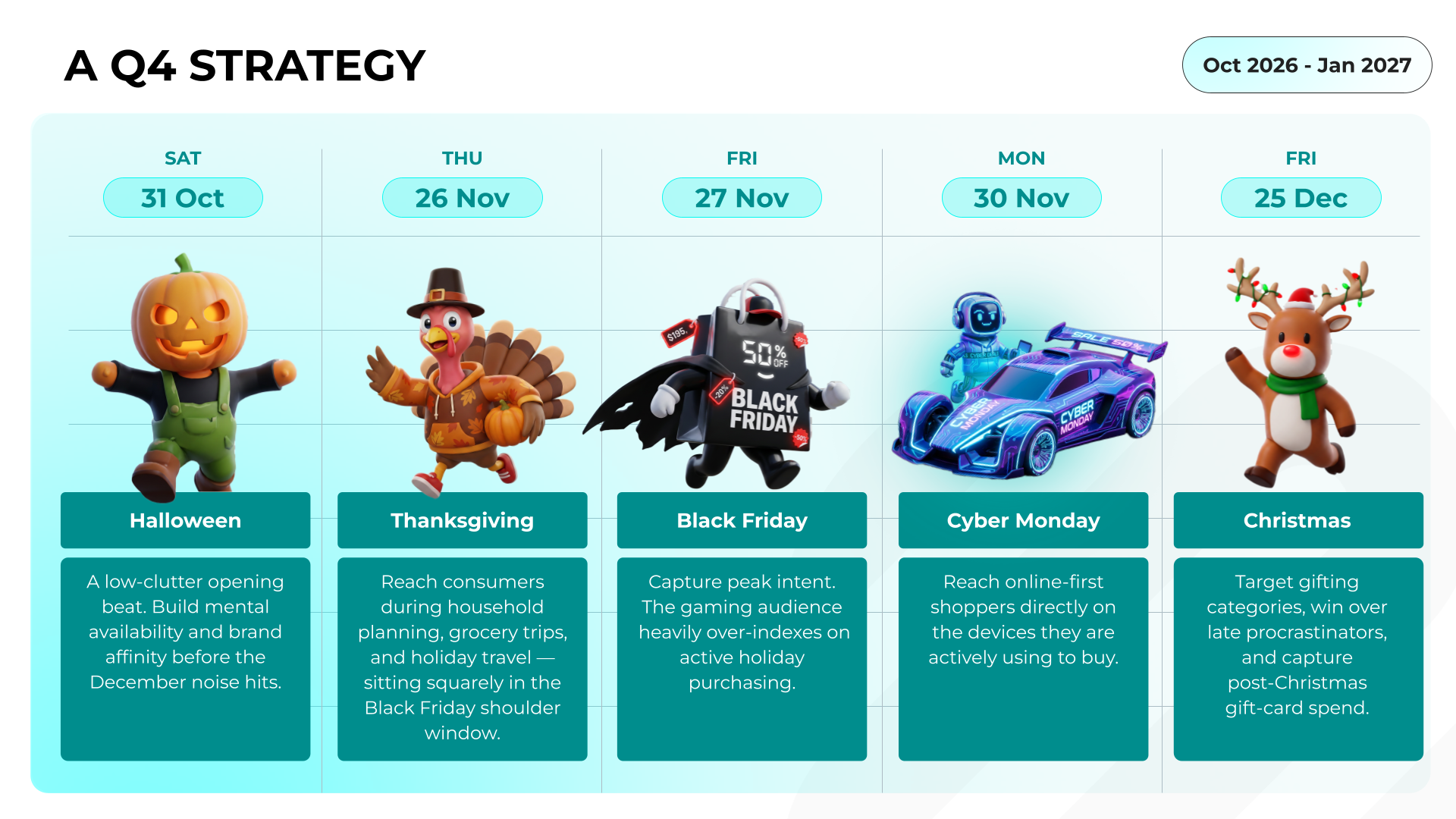
Instead of viewing gaming as a single "Black Friday" line item, think of it as five distinct consumer moments sequenced as one continuous, highly effective campaign.
Intent and Context: Matching Shoppers with the Right Verticals
The gaming audience doesn't just passively play; they actively buy. Comscore data shows that this demographic is highly transactional.
Anzu’s audience is 36% more likely to have purchased during Black Friday and 17% more likely to have purchased during Cyber Monday compared to the total US online population.
But a truly strategic holiday campaign requires looking at the nuance. This audience doesn’t just blindly over-index on everything — they index heavily on what each specific holiday actually sells.
For Halloween, they over-index on costume, character, and fan culture (showing a 37% higher likelihood of attending a gaming convention). For Christmas, they over-index on the premium items sitting under the tree — led by high-ticket consumer electronics bought online at an incredible index of 323.
By aligning the right product category with the right holiday moment, brands can build real consumer trust and drive massive real-world conversion.
The Four-Phase Playbook: Pacing for Maximum ROI
To maximize budget efficiency, brands should pace their campaigns across four phases mapped to demand, rather than relying on a single, high-cost burst:
1. Tease (Early October): Build awareness while CPMs are at their lowest point of the quarter, using always-on intrinsic ads at a low frequency cap.
2. Build (Late Oct – Mid-Nov): Activate around Halloween, then weight spend heavily into the Black Friday shoulder week where marginal ROI peaks.
3. Peak (Thanksgiving – Cyber Monday): Convert declared shopping intent using interactive, high-impact formats like clickable intrinsic and rewarded video.
4. Finish and Sustain (December): Capture late-season procrastinators, then sustain the momentum to work the post-Christmas gift-card and returns window.
Don't let your brand get lost in the peak-week noise this holiday season. Contact our team today to explore custom audience plans, tailored format recommendations, and strategic data insights designed specifically for your unique goals and make your Q4 budget work harder.