
May 13, 2025

The gaming audience is rapidly shifting, transitioning from a misunderstood niche to a central pillar of mainstream consumer spending. Data drawn from Anzu's US audience insights and intrinsic in-game advertising (IIGA) trends reports unequivocally proves that today’s gamers are engaged, financially capable, and highly diverse shoppers. They are parents and high-value consumers whose spending habits challenge outdated media stereotypes, demanding sophisticated, data-driven retail strategies.
This analysis is designed to equip media planners and buyers on retail accounts, and game developers with an in-depth, actionable understanding of where this audience spends its wealth and how to engage them effectively within the dynamic, year-round gaming environment.
The High-Value Gamer: Purchasing Power Redefined
The modern gamer is defined by substantial spending capacity and a strong tendency toward immediate consumption, focusing on lifestyle, quality, and convenience.
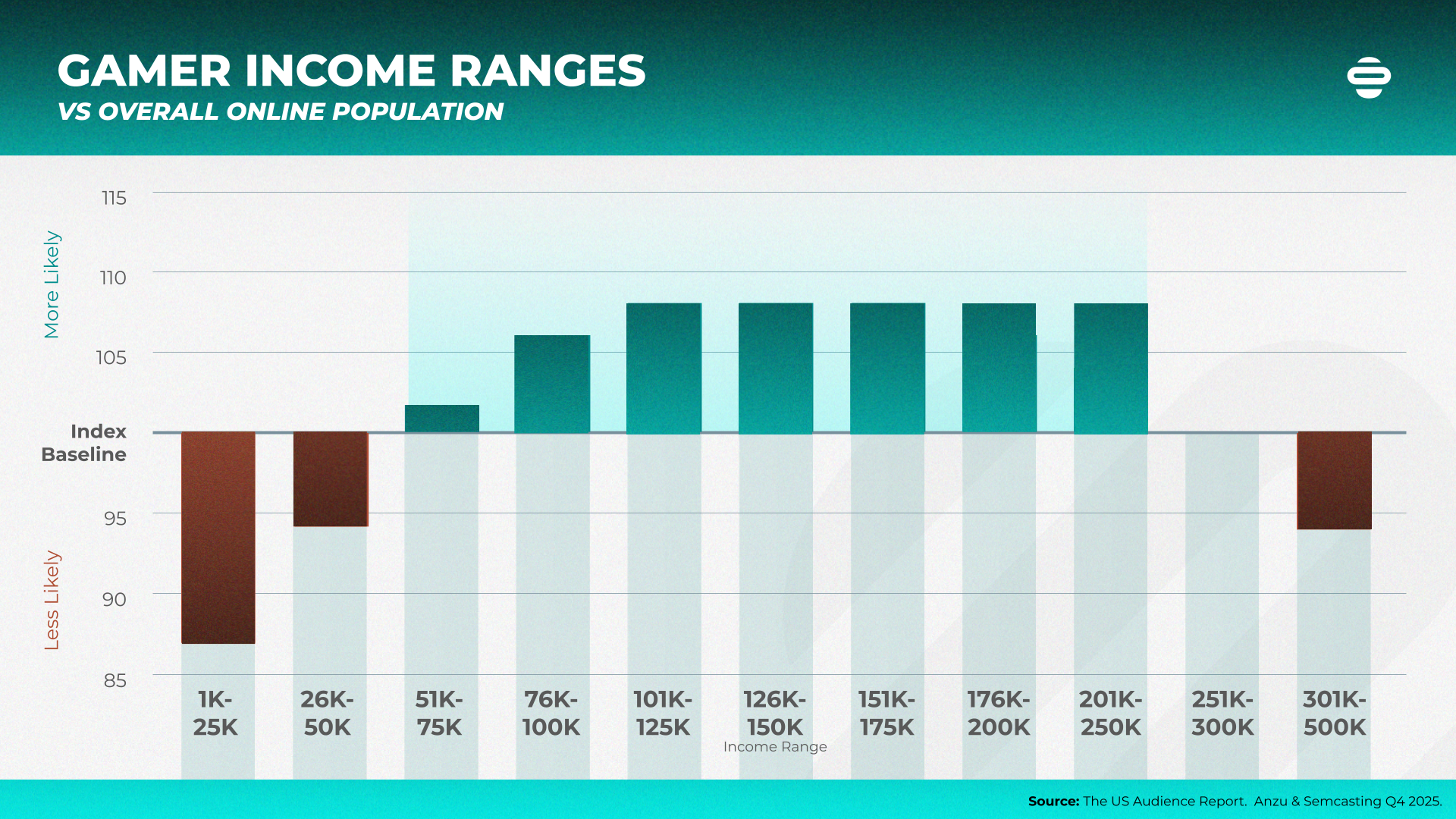
Gamers are concentrated in the middle-income brackets, specifically over-indexing in household incomes between $51K and $250K. This group shows a distinctive preference for consumption: they significantly over-index in discretionary income, demonstrating a willingness to spend rather than save or build assets. The propensity for spending is also clearly visible in their high digital consumption, showing a very strong concentration in the $5,000 to $7,499 bracket for total Internet spend in the last six months (Index 195.0).

The Family-Oriented Consumer
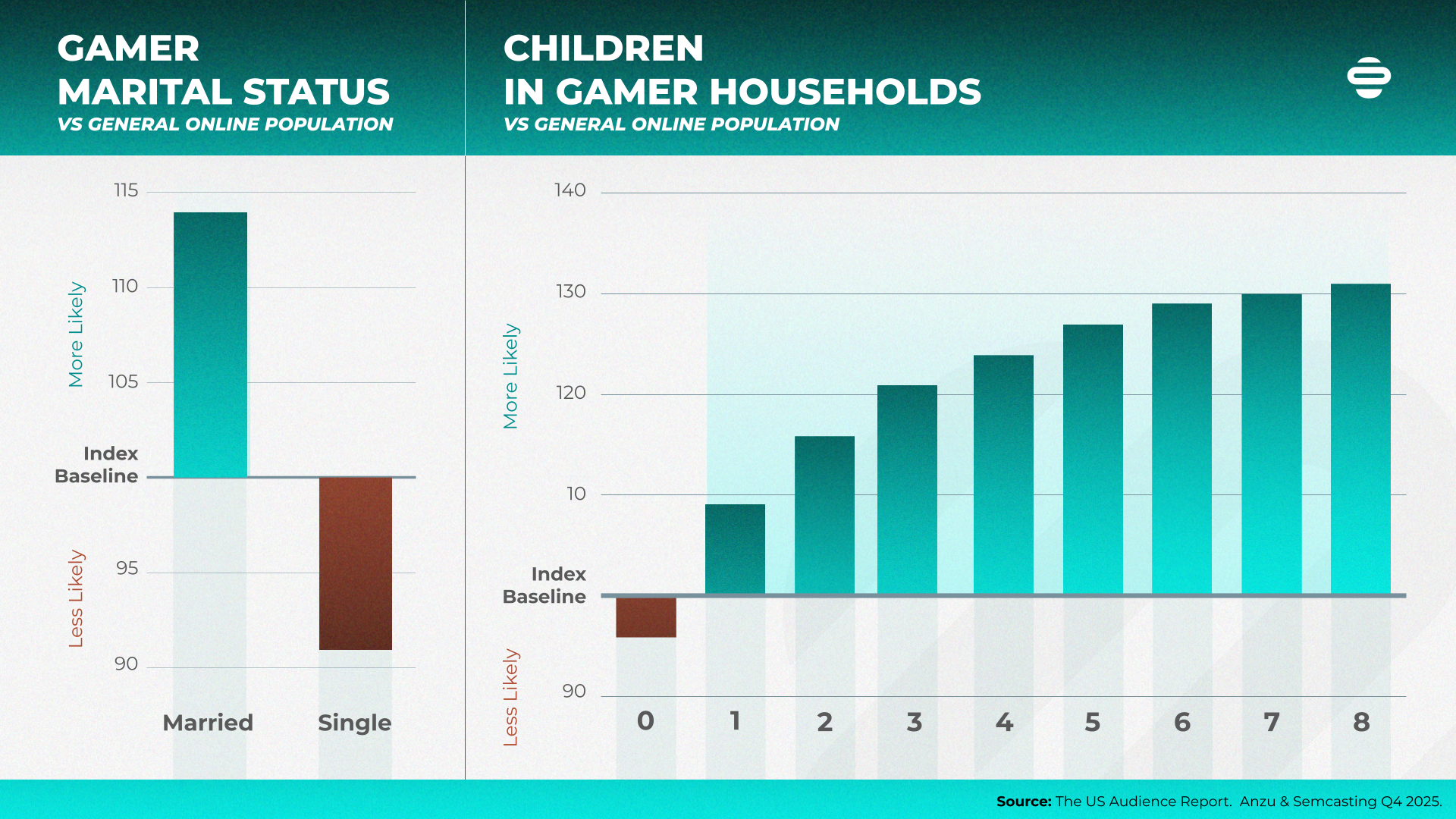
Far from the "solitary pastime" cliché, gaming is increasingly a social and family activity. The data confirms that gamers are fundamentally family-oriented, often living in larger households and actively engaging in family roles:
- Gamers over-index for marriage and often live in larger family households compared to the general online population.
- They confirm their role as Parents (Index 113.0).
- Spending reflects this domestic focus, with significant over-indexing in family-related retail. Purchases of Baby accessories (e.g., strollers, cribs) in the $100–$199 range index at an extraordinary 185.0, and spending on Kids clothing ($100–$199) indexes strongly at 148.0.
Retail Categories: Spend Beyond Expectations
The depth of gamer spending spans mainstream and luxury retail categories, proving they are highly diversified consumers actively purchasing for themselves and their households.
Beauty and Cosmetics: The Luxury Spender
Gamers represent a high-value audience for the beauty sector, demonstrating a remarkable capacity for luxury spending, particularly in cosmetics.
- Spending $500 or more on Cosmetics (online/offline combined in the last six months) yields an exceptionally high index of 247.0.
- High spending is also notable in the skincare category, with purchases between $200 and $499 indexing at 115.0.
- This engagement extends to beauty services and specialty retailers; gamers over-index in visiting hair/nail salons or barber shops within the last seven days (Index 126.0) and shopping at specialty stores like Crabtree & Evelyn (Index 146.0).
Grocery Store Shopping: Quality Over Price
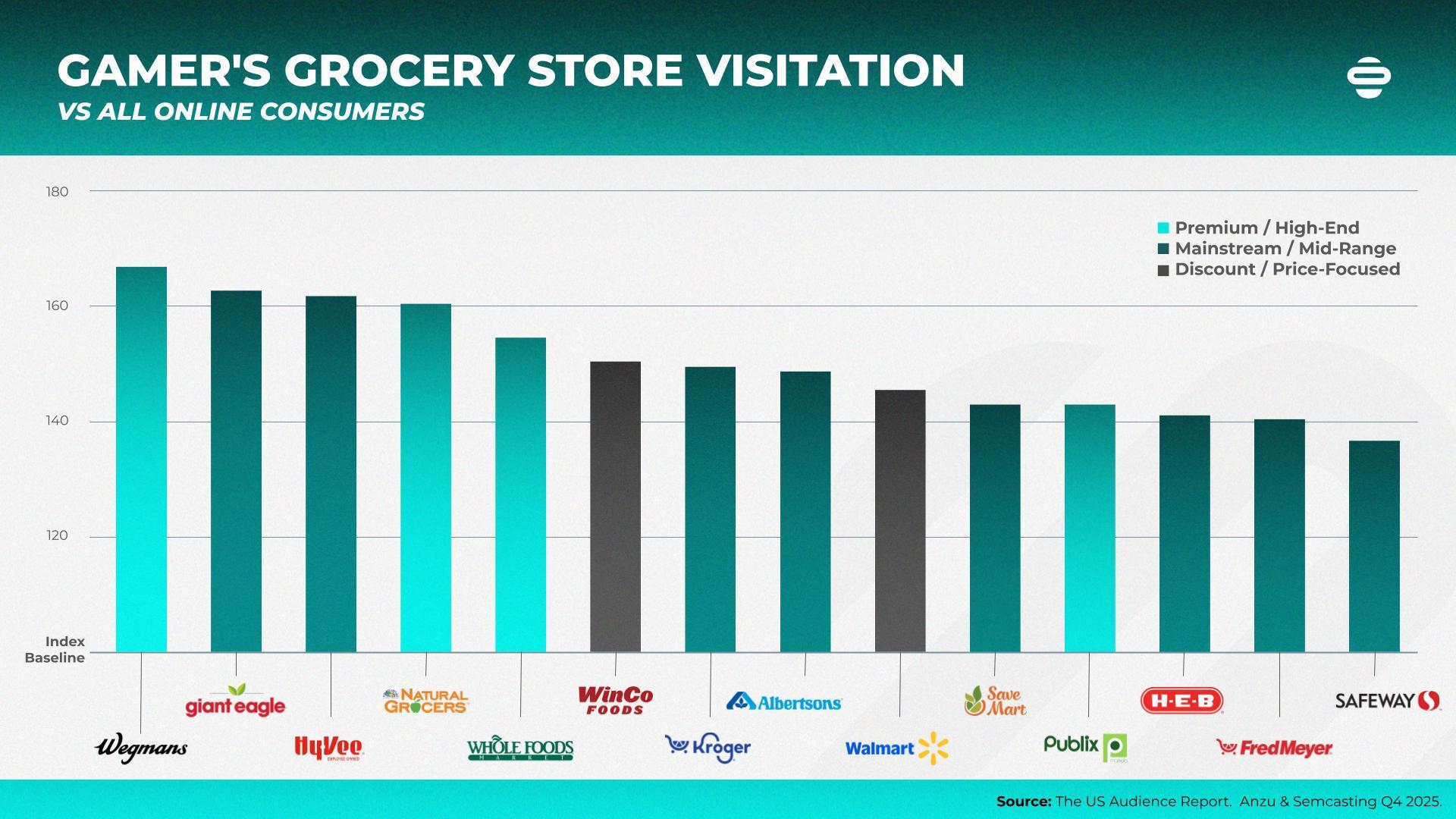
In grocery retail, gamers prioritize quality and are less inclined toward budget shopping, making them attractive targets for mid-to-high-end grocery chains.
- Gamers show a distinct preference for premium grocery stores, valuing quality over price, and tend to shop in-store more often than visiting discount chains.
- They over-index in visitation to premium/high-end grocers such as Wegmans (Index 165.0).
- They are engaged shoppers, indexing at 135.0 for spending $100 to $199 on groceries/food staples in the last 30 days and 108.0 for buying groceries/food staples offline in the last 30 days.
Apparel, Accessories, and Home Goods
Gamers are consistent purchasers across core retail categories essential for modern, active lifestyles.
- High spending on Sports clothing/shoes ($500 or more) indexed at 164.0.
- In accessories, high-tier purchases of Sunglasses ($500 or more) indexed strongly at 246.0.
- For the home, purchases of large appliances at the $200–$499 spend level index at 133.0. They are also highly involved in necessary domestic purchases, indexing at 129.0 for spending $200–$499 on Disinfecting/Antibacterial products.
Unsurprising Category: Consumer Electronics
While gaming might suggest strong consumer electronics spending, the depth of this audience’s investment in technology reinforces their high purchasing power across both gaming-specific and general tech hardware.
- Gamers show exceptionally high spending on electronics offline, with spending in the $7,500 to $9,999 bracket indexing at 323.0.
- They are heavy purchasers of gaming-related equipment like Web-enabled video game consoles bought offline (Index 174.0).
- They actively research future tech, indexing at 133.0 for searching for information on Virtual Reality devices. Furthermore, they buy high-quality supporting home electronics, indexing at 160.0 for buying Home Theater Speakers or Soundbar online.
Advertising Receptivity and Trust Signals
The gaming audience is highly receptive to advertising when integrated authentically and transparently, viewing in-game ads as a valid source of information and inspiration for purchase.
Gamers strongly over-index in translating ad exposure into action: they index at 133.0 for searching for more information about a product/service seen in a video game, and index at 123.0 for purchasing a product or service as a direct result of an in-game ad.
Purchase decisions are powerfully driven by video content, evidenced by an index of 151.0 for purchasing a product/service after watching a video product review.
This audience cares deeply about brand ethics: they index highly for caring about content that values and embraces authenticity (Index 125.0) and valuing Diversity, Equity, and Inclusion (DE&I) in the media (Index 123.0). They are more likely to buy from brands that authentically showcase diversity and inclusion (Index 102.0).
Seasonal Opportunities and Advertiser Demand by Genre
The intrinsic in-game advertising landscape offers strategic opportunities throughout the year, capitalizing on consistent player engagement and fluctuating advertiser demand across specific genres.
Seasonal CPM and Engagement Trends
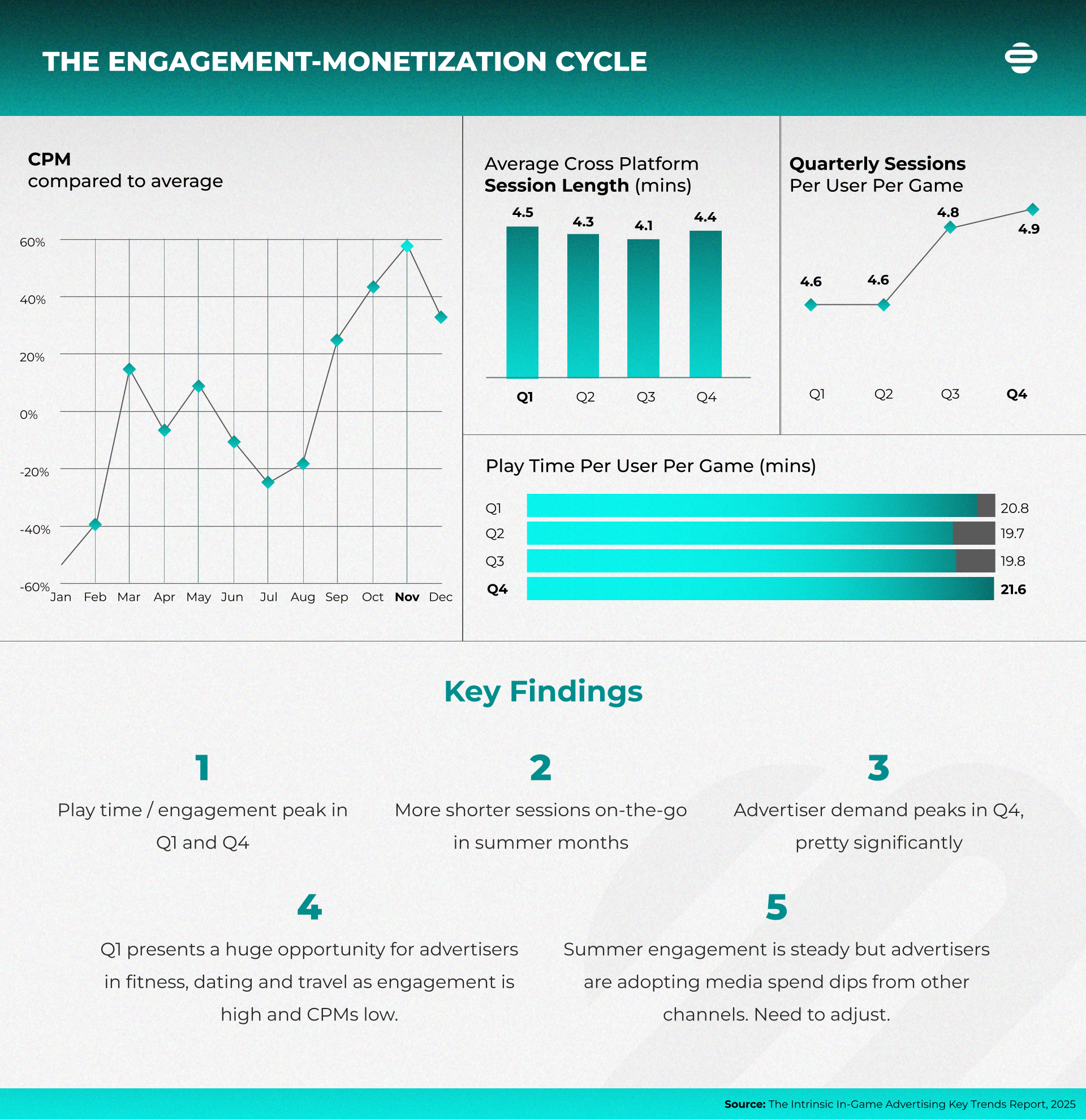
Gaming offers a unique media advantage as player engagement remains remarkably consistent year-round, unlike traditional media which sees summer dips.
Genre-Specific Retail Opportunities
CPMs vary significantly by genre, allowing planners to optimize media spend based on audience profile and cost efficiency.
- Sports Games (Highest CPM): These games command the highest CPMs, but deliver extremely engaged audiences tied to real-world seasons. They are a prime target for sportswear and lifestyle brands, especially during the Q4 holiday surge in engagement and high consumer spending.
- Action Games: Typically skew male, with peaks among young adults (18-22) and older, affluent adults (50-59). Their playtime increases during Q4 school holidays. They are ideal for brands targeting Tech, Premium travel, and Financial services. They offer high playtime at lower CPMs than Sports games.
- Simulation Games (Steady Value, Female Skew): These audiences are generally affluent, skew more female, and show interest in lifestyle, fashion, and home activities. They drive strong advertiser demand from Retail, eCommerce, and Fashion brands during peak Q4 sales, even though player engagement is steadier.
- Racing Games (Cost Efficiency): Racing games, despite high engagement peaks in Q2 and Q4, offer surprisingly low CPMs in Q4. This provides a cost-effective route for Automotive brands and related luxury apparel to connect with enthusiasts when motor racing series reach their climax.
- Arcade/Puzzle/Casual Games (Low Cost, High Attention for Video): These genres offer the lowest CPMs (ranging from 30.8% to 46.2% of Sports CPM). Their slower pacing creates opportunities for longer-form messaging, making them suitable channels for retailers focused on awareness or detailed product information through video ads.
Actionable Takeaways for Retail Campaigns
The modern gaming audience is too economically influential and diverse to be treated as an afterthought. Media planners and buyers on retail accounts must integrate in-game advertising (IIGA) as a core pillar of their strategy, utilizing data to move beyond demographics and into precise behavioral targeting.
- Re-Evaluate the Luxury and Discretionary Consumer: Stop limiting gaming budgets to youth or tech. Allocate significant retail dollars to in-game platforms, specifically targeting demonstrated high-spend categories like Cosmetics (Index 247.0), Luxury Accessories (Index 246.0), and High-End Groceries (Wegmans Index 165.0). These indices confirm that gamers are willing to spend premium money on quality lifestyle products.
- Utilize Seasonal CPM Efficiency (Buy Low, Target High): Leverage the low CPM period of Q1 when player engagement remains high. This is the strategic "efficiency window" for retail verticals like Wellness and Travel, allowing brands to secure substantial reach and frequency at a lower cost before the holiday spike.
- Harness Genre Specificity for Product Alignment: Tailor retail messaging to the player mindset within each genre. Place high-value, convenience-based retail campaigns (e.g., delivery apps, meal kits) with Action and Simulation gamers, who are typically high spenders and rely heavily on delivery services. Target Sports and Racing genres for apparel, automotive, and high-energy brand sponsorships, recognizing the peak demand and higher CPMs during Q4. Use low-CPM Casual/Puzzle environments for video ads requiring greater attention and complex retail messaging.
- Prioritize Authenticity to Drive Conversion: Recognize that gamers are highly responsive to in-game ads (Index 123.0 for purchase as a result of seeing an ad), but they demand authentic, values-driven messaging. Retail creative must be non-disruptive, contextually relevant to the game environment (Index 107.0), and align with the audience’s preference for authentic brand representation.
- Focus on the Family Unit: Plan campaigns around the acknowledged family-centric nature of the audience (Parent: Yes, Index 113.0). Campaigns for baby gear (Index 185.0), kids clothing (Index 148.0), and major home improvements should integrate IIGA to reach the household decision-makers efficiently.

Simon Whittick is Anzu's Director of Product Marketing.